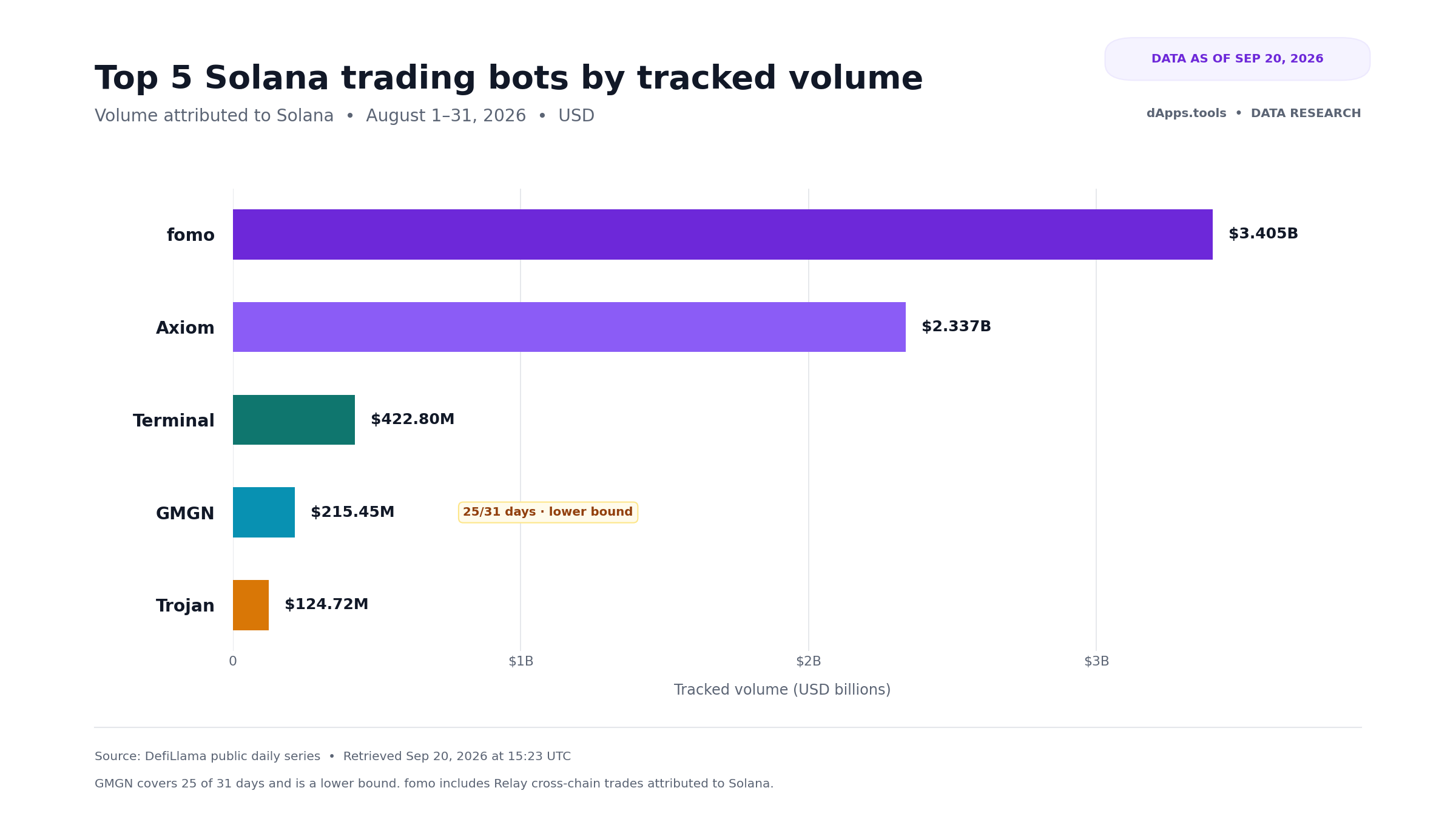
fomo, Axiom, Terminal, GMGN and Trojan are the top five Solana trading bots in our latest 2026 data snapshot. We ranked eligible trading apps, browser terminals and Telegram bots by DefiLlama volume attributed to Solana from August 1 through August 31, 2026. fomo led with $3.41 billion, followed by Axiom at $2.34 billion. This is an activity ranking, not a recommendation or a measure of safety, execution quality or trader returns. We update the same article periodically using the latest complete calendar month.
Key takeaways
fomo ranked first with $3.41 billion in tracked volume attributed to Solana, 45.7% more than Axiom.
Axiom ranked second by volume but generated the most tracked user fees ($40.33 million) and protocol revenue ($24.21 million).
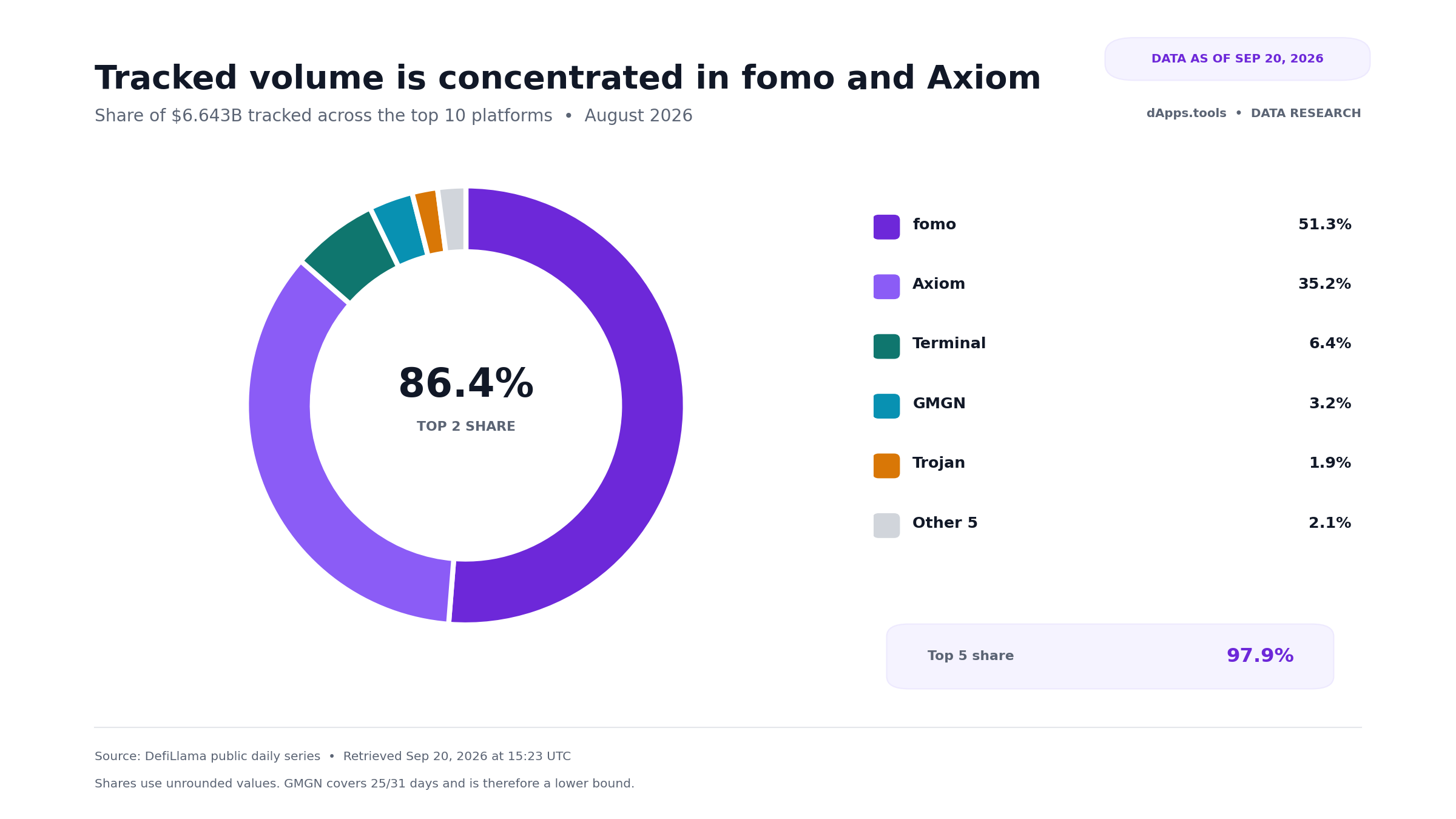
The top five represented 97.9% of the $6.64 billion measured across the 10 platforms in the comparison table.
GMGN's $215.45 million is a lower bound because its volume series contains only 25 of 31 August days.
User or wallet counts are not compared because no consistent public series uses the same definition and period across the candidates.
What is a Solana trading bot?
A Solana trading bot is software that helps users execute or automate token trades on Solana. The interface may be a Telegram bot, a website, a mobile app or a combination of these. Common functions include market and limit orders, dollar-cost averaging (DCA), take-profit and stop-loss rules, copy trading, wallet tracking and fast buying around token launches.
“Bot” does not mean every trade runs without user input. Some products are full trading terminals with optional automation, while others create a wallet inside Telegram and execute commands from chat. In both cases, users still face network fees, platform fees, slippage, token risk and the security risks of the selected wallet model.
How we ranked the top Solana trading bots
We screened 17 products that execute trades on Solana and had a verifiable official site or channel. The universe included trading apps, browser terminals and Telegram bots.
For each candidate, we retrieved DefiLlama's public daily volume, fee and revenue series and isolated the Solana chain breakdown for the same calendar month.
We ranked candidates by the sum of tracked USD volume. We did not annualize partial coverage, estimate missing days or convert fees into implied volume.
Fees and protocol revenue were used as supporting context, not blended into a composite score. A single comparable volume metric was available for 16 candidates, so a weighted score was unnecessary.
We reviewed adapter coverage and product status, then displayed the 10 largest comparable results. moonshot.money ranked just below the table at $16.92 million, followed by BullX at $12.40 million. Maestro had comparable fees but no public Solana volume series and was left unranked.
DefiLlama adapters identify activity through routers, fee wallets, transaction labels or decoded trades. Their coverage is not identical. In particular, fomo's Solana series includes native Solana swaps and Relay cross-chain trades that DefiLlama attributes to Solana because user balances are held there. GMGN has 25 days of volume coverage and PepeBoost has 19; both figures are lower bounds. Historical values can also change when an adapter is corrected.
Registered users, connected wallets, fee-paying wallets and daily active addresses are different measures. Mixing them would create a misleading comparison, so active-user data is shown as not publicly comparable rather than estimated. Revenue means the portion of tracked fees retained by a protocol under the adapter's method; it is not net income or profit.
1. fomo, largest tracked volume attributed to Solana
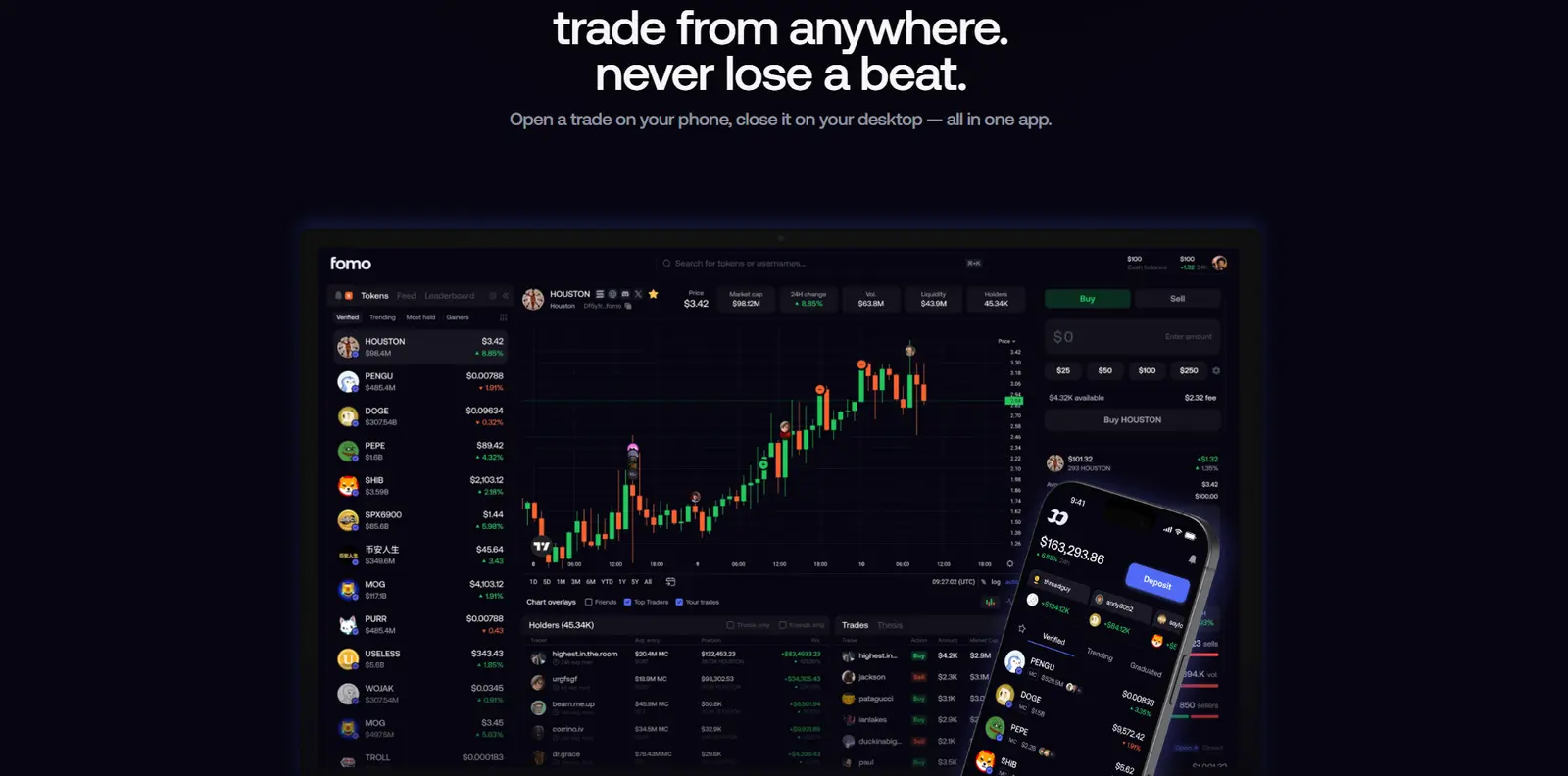
fomo ranked first with $3.405 billion in tracked August volume. Its corresponding fee series recorded $16.07 million in user fees and $14.64 million in protocol revenue, with observations for all 31 days. It represented 51.3% of the volume in the 10-product table.
fomo is a social trading app available on the web, iOS and Android. It combines spot trading, trader feeds, alerts, leaderboards, portfolio and profit-and-loss tracking, and perpetual futures. Users receive an embedded non-custodial wallet through Privy and can export its private keys. A unified USD balance can be used across supported networks without manually maintaining a gas token on each one.
Fees: fomo's terms do not publish one fixed spot-trading percentage. The fee varies with the transaction size, type, token and route and is displayed before confirmation. Network, liquidity and execution costs can be separate. The published fomo fee for perpetual futures is 0.05% per transaction, in addition to third-party fees and funding payments.
Best suited to: traders who want social discovery and continuity between web and mobile across several networks.
Points to verify: the number used for this rank is not limited to native Solana swaps; it includes Relay cross-chain trades assigned to Solana by the adapter. Users must also secure the account credentials and exportable keys behind the embedded wallet.
2. Axiom, second in volume and first in tracked fees
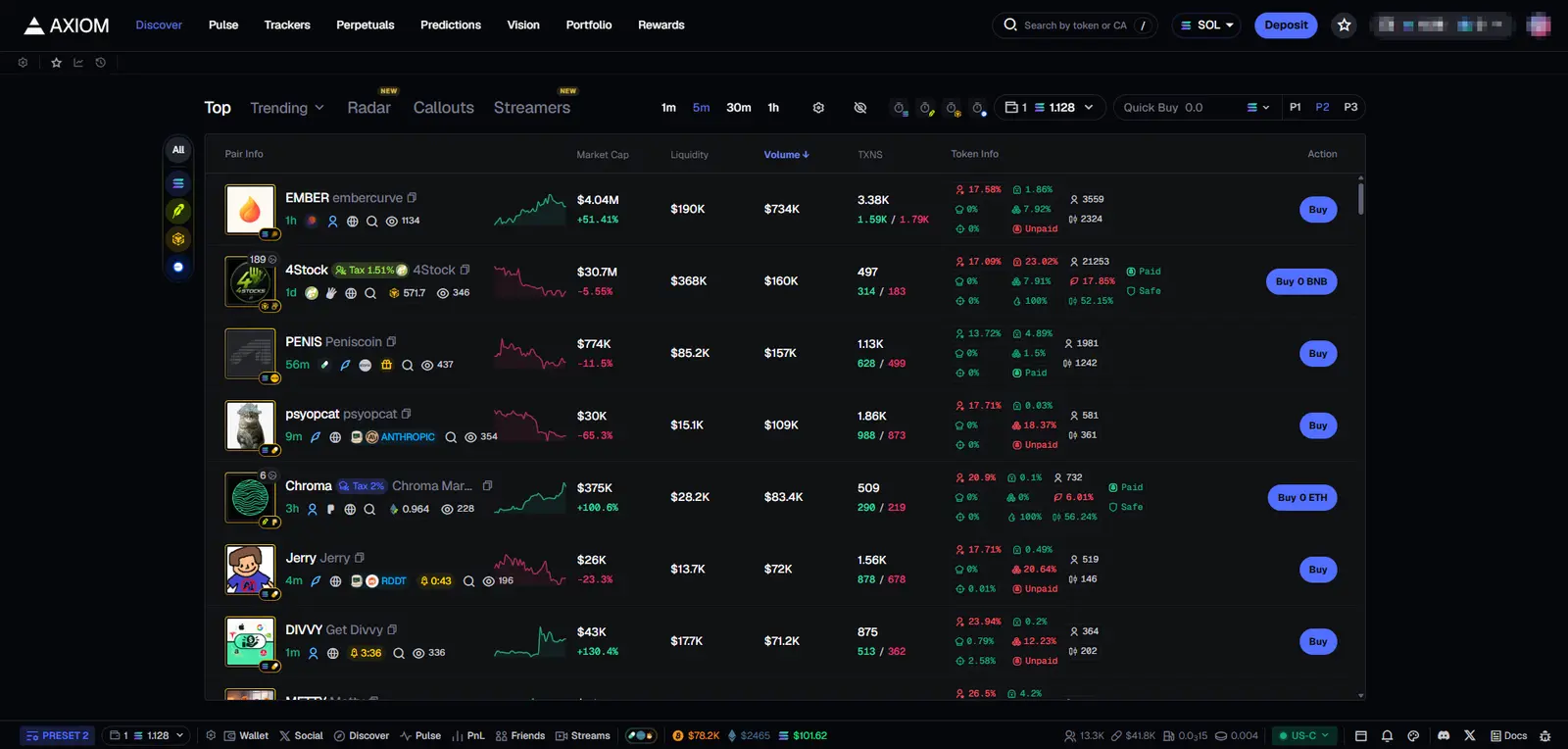
Axiom ranked second with $2.337 billion in tracked August volume. It led the comparison on supporting financial metrics: $40.33 million in user fees and $24.21 million in protocol revenue. All three series contain 31 daily observations.
Axiom is a browser-based terminal built around Solana token discovery and order execution. Pulse groups newly created, migrating and recently migrated tokens; Explore adds market, liquidity and holder filters. Users can place market, limit and instant trades, monitor addresses with Wallet Tracker, inspect trader activity and manage several wallets from one workspace. A separate perpetual-futures flow uses Hyperliquid.
Fees: Axiom's official schedule lists a 1% gross trading fee with tiered cashback. The resulting net fee ranges from 0.95% at the Wood tier to 0.75% at Champion. Priority fees, optional MEV settings, network costs and the separate Hyperliquid fee structure can add to the total.
Best suited to: active browser-based traders who want token discovery, orders and wallet monitoring in one interface.
Points to verify: its feature density and execution settings can be more complex than a simple swap, and the adapter states that swaps routed through venues it cannot decode are excluded, making tracked volume a floor.
3. Terminal, third-largest tracked volume
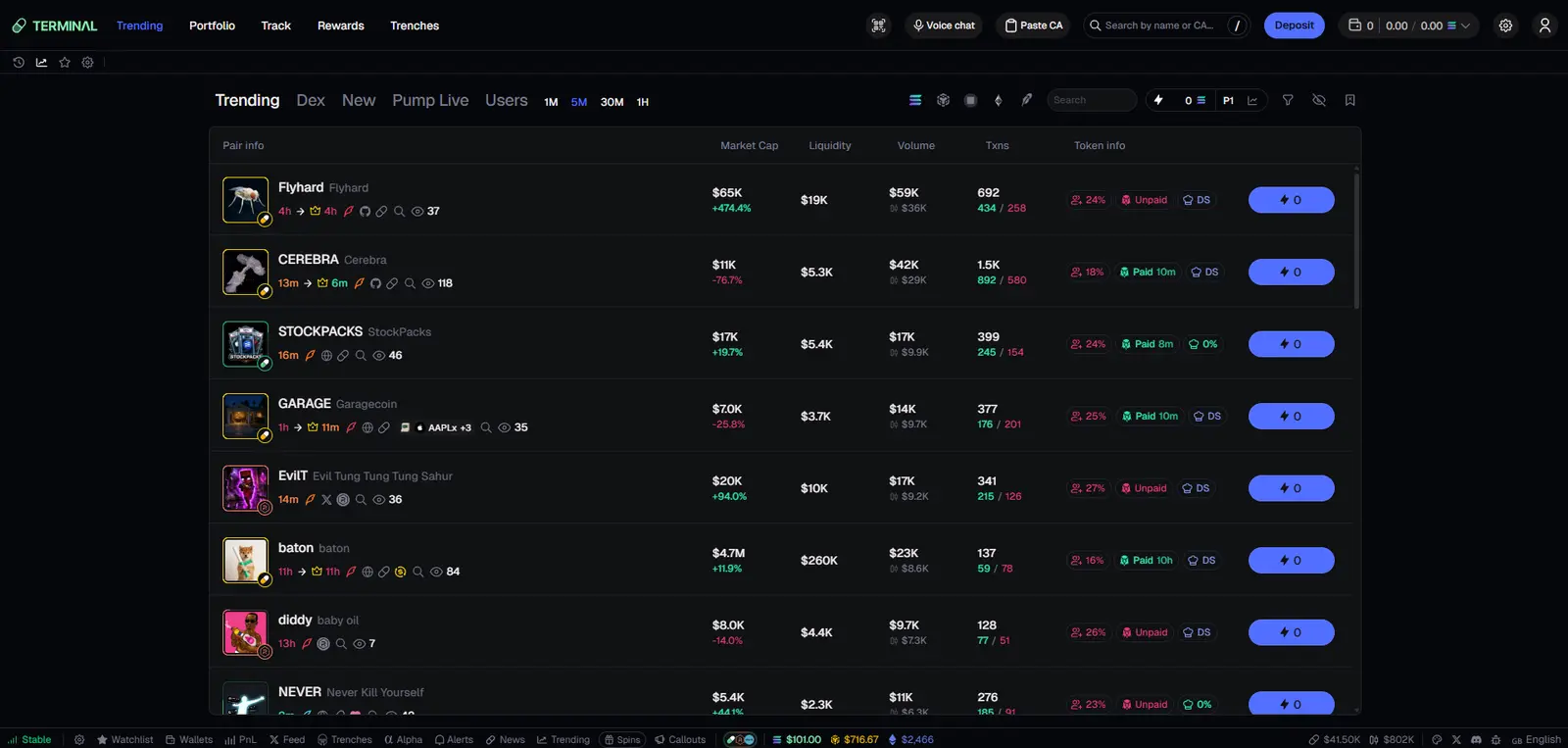
Terminal, previously known as Padre, ranked third with $422.80 million in August volume. DefiLlama tracked $5.29 million in user fees and $2.94 million in protocol revenue, each with 31 days of coverage.
Terminal is a browser-based multichain workspace for meme-token discovery, charts and execution. Its tools include routed swaps, transaction simulation, limit orders, copy trading, buy-the-dip triggers, take-profit and stop-loss levels, wallet monitoring and portfolio views. Its public product material lists Solana, Ethereum, Base and BNB Chain.
Fees: Terminal states that a transaction can carry a platform fee of up to 1%. Blockchain network charges and fees from third-party protocols may be separate, so the pre-trade quote is the practical source of the current total.
Best suited to: users who want discovery, charts, automation and portfolio tracking in a web terminal.
Points to verify: most trading and wallet screens require sign-in, product documentation is less open than for some rivals, and order execution still depends on liquidity, slippage and third-party infrastructure.
4. GMGN, broad research tools
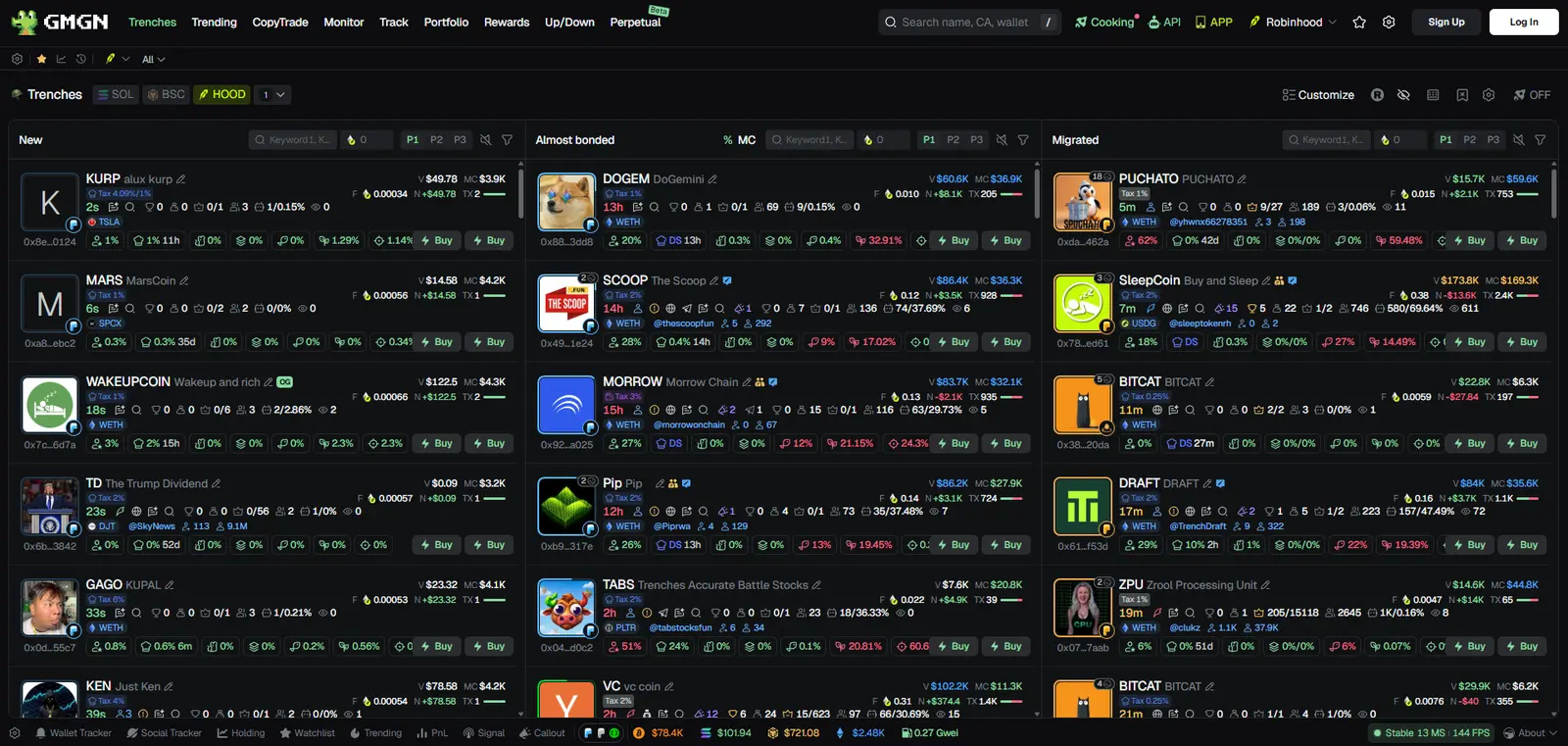
GMGN ranked fourth with $215.45 million in observed August volume. That series contains only 25 days, so the result is a lower bound. Its complete 31-day fee series recorded $4.89 million in user fees and $3.43 million in protocol revenue.
GMGN combines public token discovery, price charts, holder analysis, wallet tracking and automated risk signals with swaps, limit orders, take-profit and stop-loss rules, trailing orders, copy trading and multi-wallet controls. The service is available through the web, an Android app and Telegram, while some API features require approval.
Fees: GMGN's documentation lists a 1% handling fee per transaction. Solana network fees, priority fees, optional tips, slippage and any launchpad-specific fee are separate.
Best suited to: users who want wallet and token research alongside trading and automation.
Points to verify: the six missing volume days reduce direct comparability, automated risk flags are not a safety certification, and high slippage or priority settings can materially change execution cost.
5. Trojan, Solana-focused orders and automation
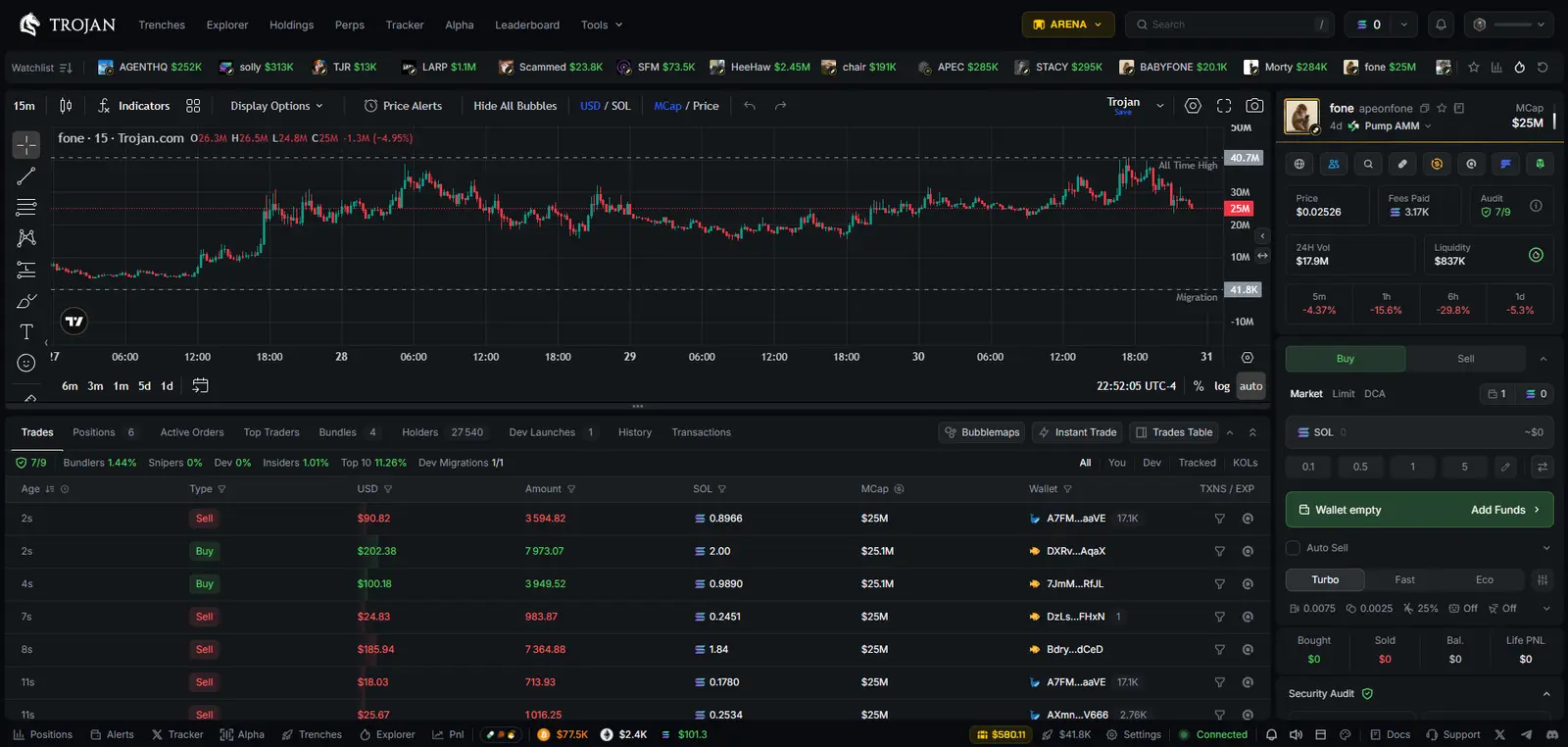
Trojan completed the top five with $124.72 million in tracked August volume. The 31-day fee series recorded $1.29 million in user fees and $989,547 in protocol revenue.
Trojan offers a Solana web terminal for desktop and mobile browsers plus a separate Telegram interface. It supports market, limit and DCA orders, copy trading, new-token discovery, wallet analysis, token checks and multi-wallet execution. Basic swaps can use a connected login wallet; advanced orders require a Trojan wallet or an imported wallet. Perpetual futures are provided through a separate Hyperliquid-powered workflow.
Fees: Trojan documents a 1% fee on each successful spot trade, with cashback that can reduce the effective cost. Solana network fees, priority fees, MEV-protection tips, slippage and token-account creation costs are additional.
Best suited to: Solana traders who want several order types, wallet research and automation in one product.
Points to verify: copied trades execute after the followed wallet, advanced wallet imports expand key-management risk, and a triggered order is not guaranteed to fill at the expected price.
Solana trading bot comparison
All monetary figures are USD and cover August 1–31, 2026.
Top 10 Solana trading tracked by volume
Rank | Bot | Platform | Tracked volume and coverage | User fees / protocol revenue |
|---|---|---|---|---|
1 | Web, iOS, Android | |||
2 | Browser terminal | |||
3 | Browser terminal | |||
4 | Web, Android, Telegram | |||
5 | Web and Telegram | |||
6 | Photon | Browser terminal | ||
7 | Bloom Trading Bot | Web and Telegram | ||
8 | BONKbot | Telegram | ||
9 | Ave.ai | Web and mobile | ||
10 | Telegram and Chrome |
The top ten account for $6.643 billion in tracked volume; the top five represent 97.9% of that total. GMGN covers 25 of 31 days and remains a lower bound. Volume, fees and revenue follow each adapter’s published definitions and can be revised. No comparable active-wallet or active-user series was available across all candidates.
How to choose a Solana trading bot
Choose the interface first. Telegram is convenient for command-driven trading, while a browser terminal usually provides denser charts and wallet analysis. Mobile apps can be easier for alerts and portfolio checks.
Compare total execution cost. Add the platform fee, network fee, priority fee or tip, launchpad or liquidity-pool charge and slippage. A lower advertised fee can still produce a worse result if routing or execution is poor.
Check the wallet model. Understand whether the product creates an embedded wallet, imports a private key, connects to an external wallet or uses session permissions. Confirm how recovery and withdrawals work before funding it.
Use only the automation you need. Limit, DCA, take-profit, stop-loss, copy-trading and sniping tools add convenience but also configuration and execution risk.
Test with a small separate wallet. Verify a deposit, one trade and a withdrawal before increasing the balance. Keep long-term holdings away from a hot wallet used for frequent bot activity.
Browse the broader Solana trading bot directory and trading tools to compare products by workflow rather than volume alone.
Risks and security considerations
Fake bots and domains: phishing accounts often copy names, logos and Telegram handles. Open the bot from a verified official site and bookmark the correct address.
Key custody: never send a seed phrase in chat. If a product requires a private-key import, use a dedicated low-value wallet and understand that the imported key controls its funds.
Permissions and sessions: review approvals, connected apps and session permissions. Disconnect access that is no longer needed and secure the linked email or social account with strong authentication.
Slippage and MEV: high slippage can expose a trade to poor execution or sandwich attacks. MEV protection and priority tips may help in some conditions but do not guarantee a fill or a specific price.
Token and liquidity risk: a bot can execute a trade successfully even when the token is malicious, illiquid or impossible to sell. Use independent research and tools such as RugCheck as additional context, not as a guarantee.
Automation risk: copied, limit or stop orders can execute later or at a different price than expected. Congestion, unsupported pools, failed transactions and third-party outages can interrupt the workflow.
Frequently asked questions
What is the top Solana trading bot in 2026?
fomo ranks first in this snapshot with $3.405 billion in August volume attributed to Solana by DefiLlama. Its adapter includes native Solana swaps and Relay cross-chain trades assigned to Solana, so Axiom is first if the comparison is restricted to the other adapters' more conventional Solana-routed activity.
Are these bots ranked by users or trading volume?
They are ranked by tracked USD trading volume from August 1–31, 2026. Users and wallets are excluded because public sources mix registered accounts, connected addresses, active wallets and fee-paying wallets across incompatible periods.
Are Solana Telegram trading bots the only products included?
No. The universe includes Telegram bots, browser terminals, mobile apps and hybrid products as long as they execute trades on Solana and have verifiable quantitative data.
How much do Solana trading bots charge?
Fees vary by product and may be reduced by cashback. The platform fee is only one part of the cost; network fees, priority tips, liquidity-pool or launchpad charges and slippage can also apply. Review the current quote before every trade.
Does a higher rank mean a bot is safer?
No. Volume measures tracked activity, not security, custody quality, token safety, execution price or profitability. Use a separate low-value wallet, verify official links and assess each product's wallet and permission model.
Conclusion
For the August data window, the order is fomo, Axiom, Terminal, GMGN and Trojan. fomo led the volume attributed to Solana, while Axiom generated the most tracked fees and revenue. These values and adapter methods can change, so check the dated sources and current fee quote before choosing a product. This same article will be updated with each new complete monthly dataset.
The linked volume and fee values in the ranking and table open each candidate’s readable DefiLlama protocol page, where readers can review the charts, current metrics and methodology. Values are rounded for readability; calculations used the unrounded daily observations available at the stated retrieval time.