Creating a token on Solana takes minutes. Finding people who will keep trading it is much harder. That gap makes launchpad leaderboards easy to misread: a busy creation feed can coexist with thin markets and launches that never move beyond their initial pricing curve.
So which Solana token launchpads are actually active in 2026? We compared observed token launches over the same 21 complete UTC days, then checked separately whether each product reports trading volume and user-paid fees. The result is a snapshot of activity, with clear gaps where the available data cannot support a direct comparison.
What is a Solana token launchpad?
A token launchpad helps someone create a token and open its first market. On many Solana launchpads, buyers and sellers initially trade against a bonding curve: a program that adjusts the quote as trades change its reserves. The creator does not need to seed a traditional liquidity pool at the start.
If a curve reaches its required threshold, the token may graduate: its trading liquidity moves to a regular exchange pool. Graduation shows that a particular launch crossed a mechanical threshold. It does not prove that the token has lasting demand, a trustworthy creator or a stable price.
How we measured launchpad activity
Our comparison covers September 4–24, 2026, inclusive (UTC). We added the daily observed token launches in MemeFees’ launch series for five identifiable Solana-facing launch products. MemeFees polls platform feeds every five minutes; nearly all daily counts for these products have incomplete coverage. Every token count below is therefore an observed minimum, not a complete chain-wide total. The order reflects those observations and could change with fuller indexing.
For the same dates, we independently summed each named product’s daily DefiLlama fees and its reported trading volume where available. Fees are what users paid, before any revenue sharing; they are not trading volume or protocol profit. Volumes refer to the named launch product, not all swaps on a related DEX after graduation.
Five Solana launch products at a glance
These figures answer different questions: launches show observed creation, volume shows reported trading on the launch product, and fees show paid activity where a volume series is unavailable.
Launch product | Tokens observed, at least | Reported trading volume | User-paid fees |
|---|---|---|---|
pump.fun | 641,872 | $1.89B | $28.96M |
Raydium LaunchLab | 103,993 | $292.47M | $7.53M |
BONK.fun / LetsBONK | 1,312 | Not reported | $6.58M |
Moonshot Create | 273 | Not reported | $63,062 |
Jupiter Studio | 157 | Not reported | $59,871 |
Period: September 4–24, 2026 UTC. Launch counts are lower bounds from MemeFees; USD volume and fee totals are summed from DefiLlama daily series and rounded. “Not reported” does not mean zero. These are distinct product series, not all transactions in their parent ecosystems.
How the launchpads work
1. pump.fun: a large creation feed and its own trading path
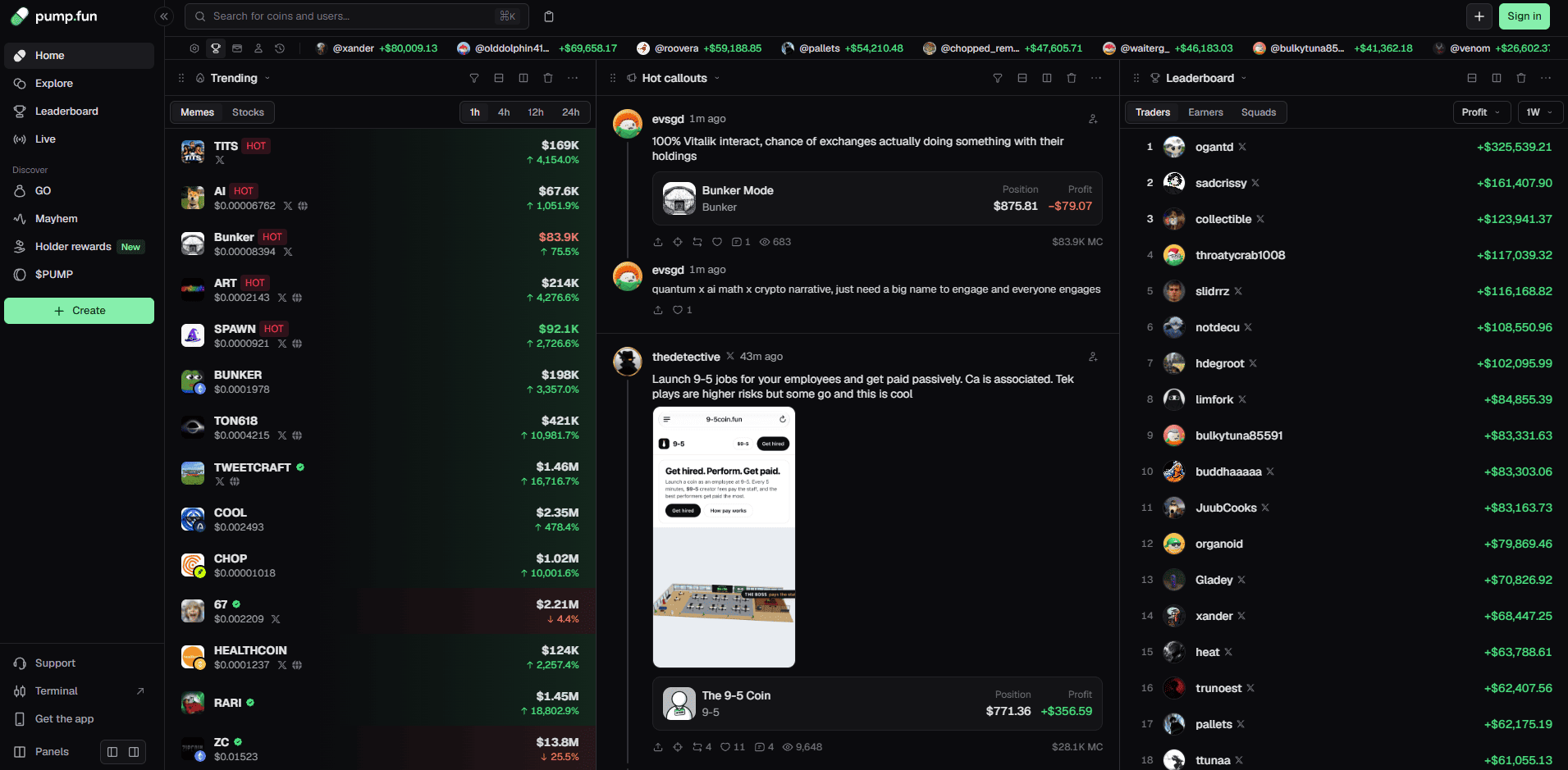
pump.fun lets a creator put a token on a bonding curve without first supplying a conventional pool. Buyers can trade it immediately. When its curve reaches the graduation threshold, liquidity moves to PumpSwap. The pump.fun profile is a useful starting point if you want to explore the product.
Its 641,872+ observed launches were the highest among the five products tracked here, alongside $1.89 billion of reported pump.fun launch-product volume. Neither number tells you how many individual tokens retained buyers. In particular, do not add all PumpSwap volume to the launch-product number: that would mix post-graduation DEX trades with initial launches.
2. Raydium LaunchLab: a quick mode and more launch settings
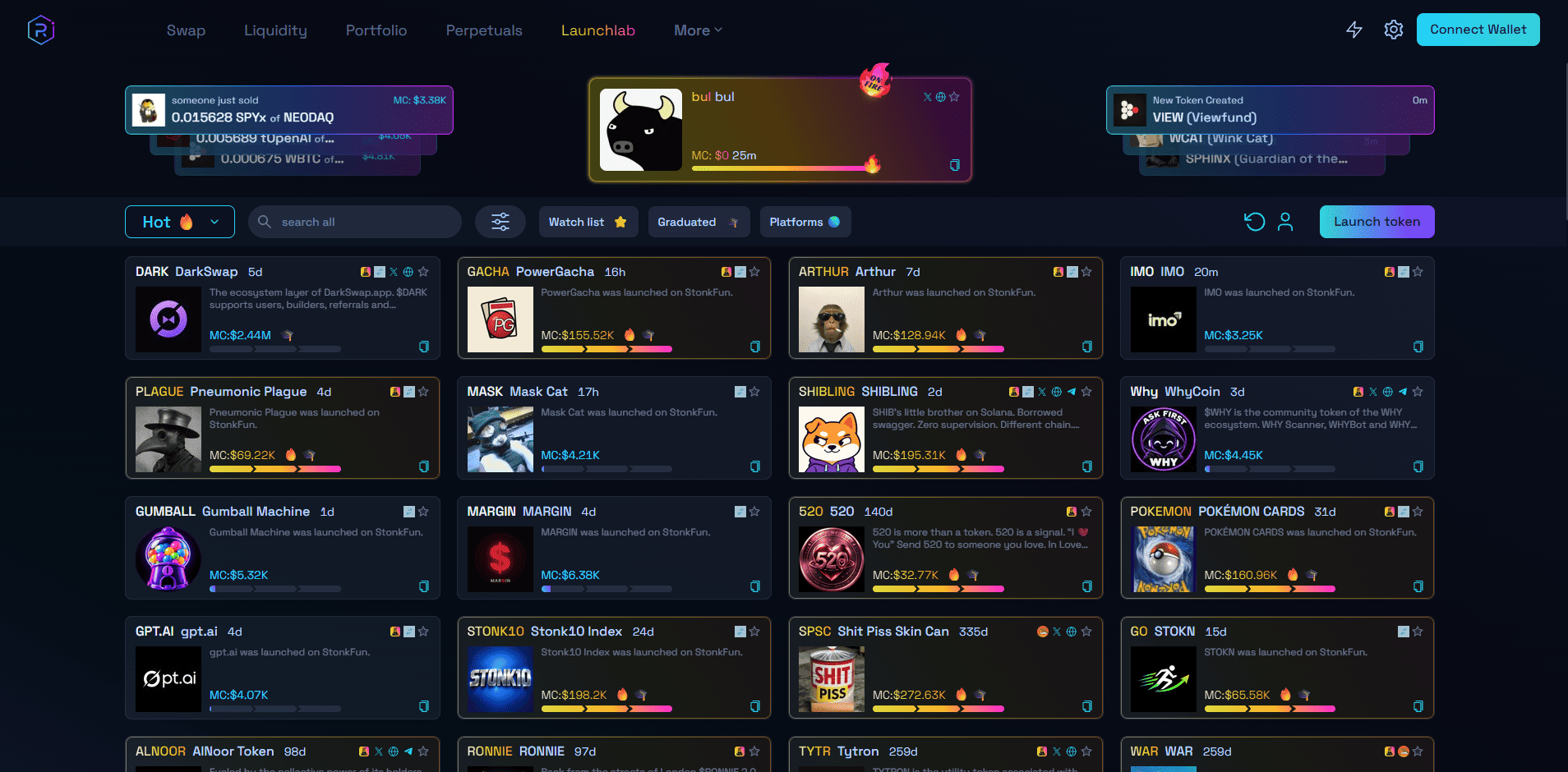
LaunchLab uses a bonding curve before moving a qualifying token to a Raydium AMM pool. Raydium describes a quick “JustSendit” mode and a configurable LaunchLab mode for choices such as supply, curve, vesting and post-migration fees. The Raydium tool page provides context on the broader exchange, which is separate from LaunchLab’s launch activity.
We observed at least 103,993 launches, with $292.47 million of reported LaunchLab trading volume. That volume belongs to the launch product; quoting the whole Raydium DEX would greatly widen the scope. The launch count shows scale, while the curve-to-pool transition explains why a token can keep trading elsewhere after leaving the launchpad.
3. BONK.fun: launch activity with a separately tracked fee stream
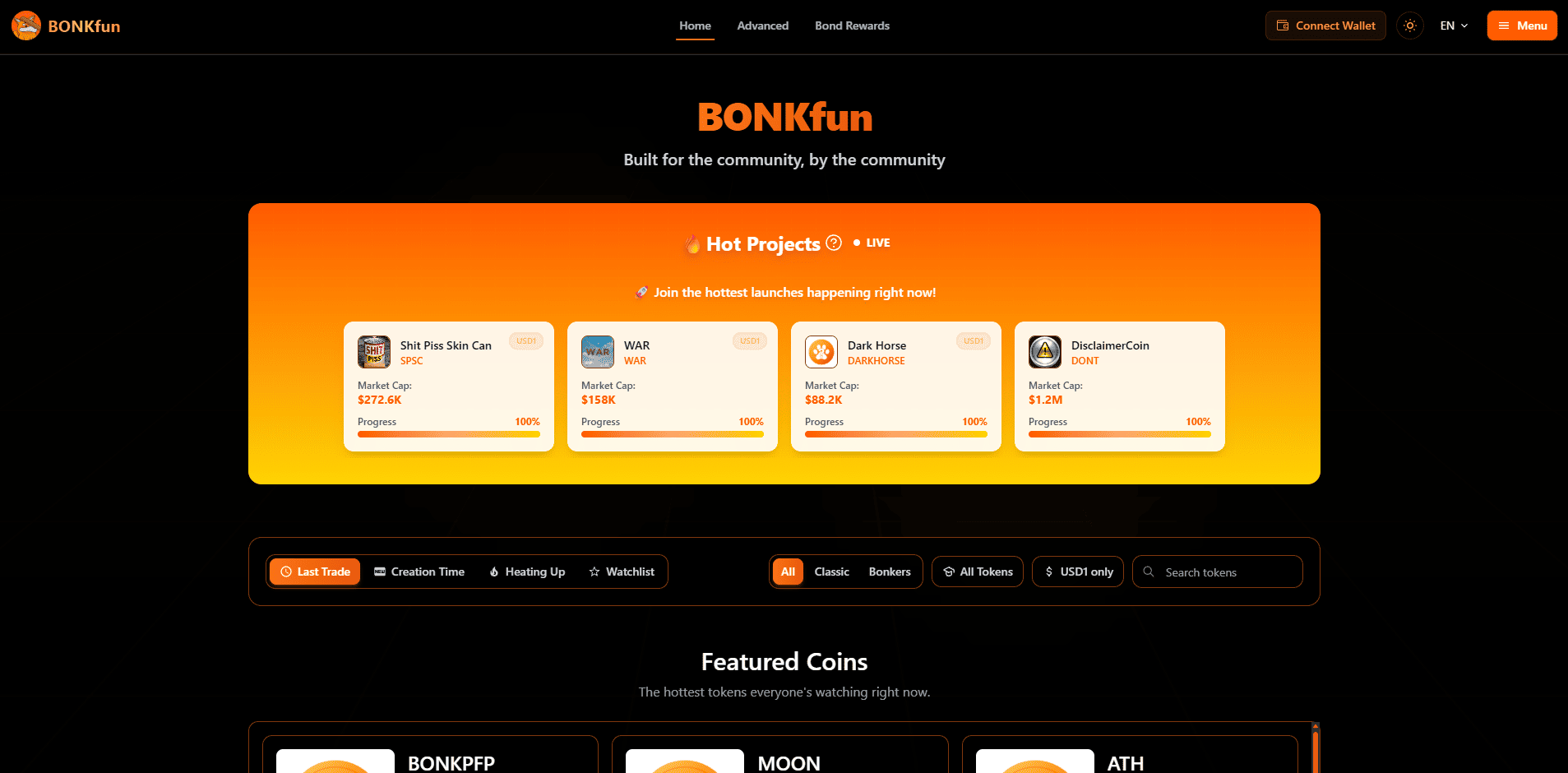
BONK.fun, also identified as LetsBONK in the launch feed, offers token creation and a bonding-curve market. Its live token pages display curve progress and post-migration information, helping a reader distinguish a new token from one that has moved on.
The feed captured at least 1,312 launches. DefiLlama recorded $6.58 million in user-paid fees for the BONK.fun Launchpad product over the same 21 days, but does not provide a corresponding launchpad trading-volume series in this dataset. That is a useful example of why a smaller observed creation count does not imply proportionally less trading. Fees also depend on the product’s fee rules; they cannot be converted into volume with a single assumed rate.
4. Moonshot Create: creation inside a consumer trading app
Moonshot combines an app for buying and selling tokens with its own token-creation flow. Its Moonshot profile covers the wider app; the figure in this comparison refers specifically to Moonshot Create. This distinction matters when reading activity reports about an app that can route or offer other trades.
The creation feed observed at least 273 tokens, and DefiLlama reports $63,062 in Moonshot Create fees for the period. It supplies no matching volume series here. Moonshot Create should also not be confused with Moonit, the separate launchpad formerly called Moonshot.
5. Jupiter Studio: adjustable launches within Jupiter
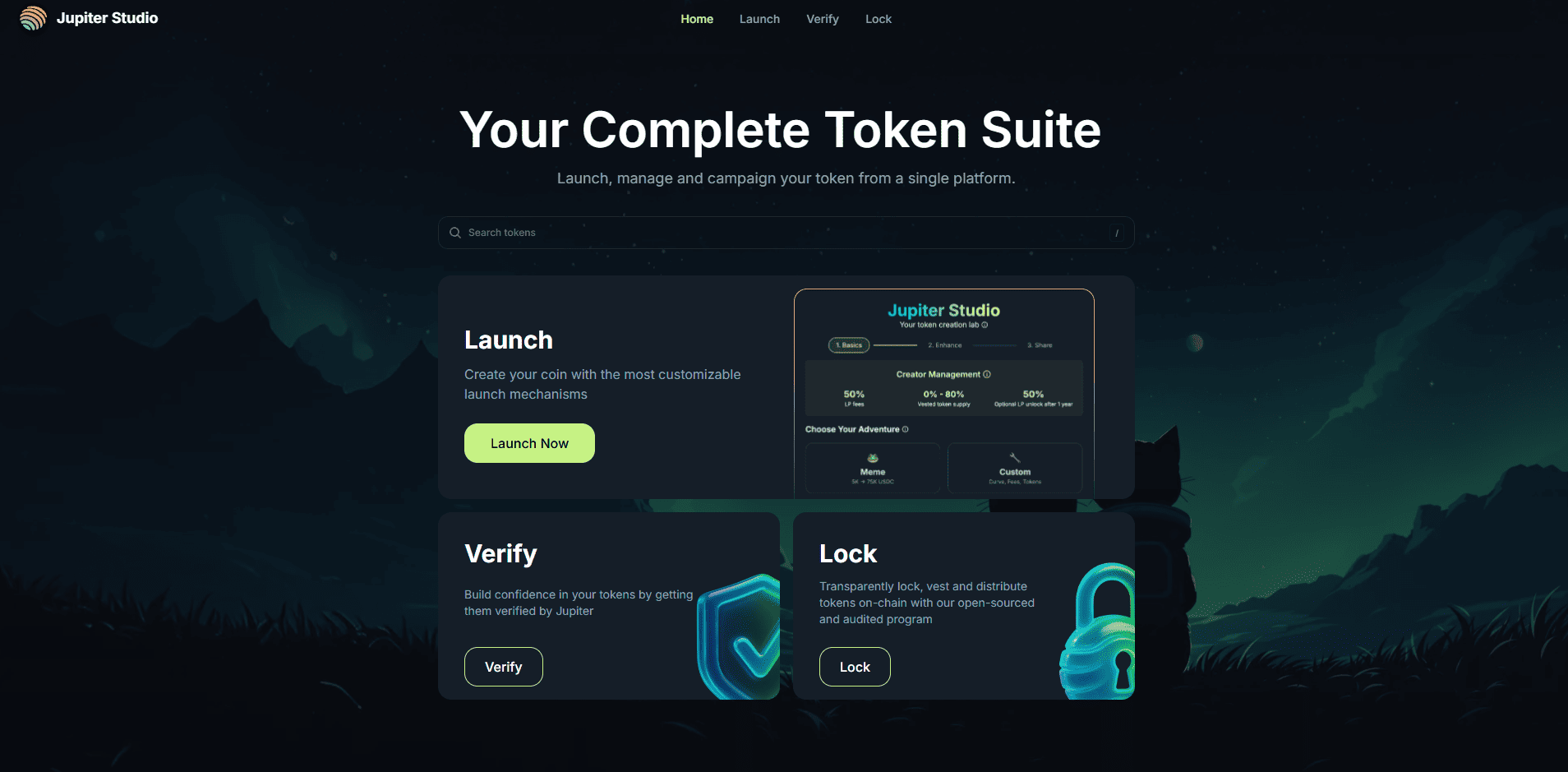
Jupiter Studio offers a preset meme mode and a custom mode with options including the quote token, graduation target, anti-sniping controls and creator vesting. When a Studio token graduates, liquidity moves to a Meteora pool. See the Jupiter profile for the wider ecosystem; Studio is one product within it.
We observed at least 157 Studio launches and $59,871 in product fees during the period. DefiLlama does not publish a corresponding Studio trading-volume series in this comparison. Jupiter’s aggregated swaps cannot stand in for Studio launch volume: an aggregator may route trades through many venues and many tokens that Studio did not create.
Where shared infrastructure changes the picture
Meteora Dynamic Bonding Curve (DBC) also recorded at least 70,876 observed launches, $325.05 million in reported curve volume and $980,000 in fees over these dates. Those are meaningful Solana launch-infrastructure figures. We keep DBC outside the five-product order because it is a configurable underlying program used by other launch experiences; treating all its activity as one independent consumer launchpad could double count or misattribute partner activity. Its volume also excludes later trading on separate Meteora pools.
Bags showed at least 1,642 launches in the source feed, but its product spans Solana and Robinhood Chain and that creation series does not provide a verified Solana-only split. We do not insert the mixed-chain count into a Solana-only order. These exclusions illustrate a practical rule: check the chain and product boundary before comparing totals.
Why there is no graduation-rate ranking
A meaningful graduation rate follows one cohort of newly created tokens and asks what share graduated within the same defined window, such as 24 hours. Dividing graduations reported today by tokens created today is different: some of today’s graduates were launched earlier. The source methodology marks cohort rates unavailable for these incompletely observed launch feeds. Platforms also set different graduation conditions.
Even a properly calculated graduation percentage would only describe crossing a curve threshold. To judge whether a project attracted lasting buyers, look at its individual trading activity and liquidity after launch and after graduation. A market can be busy because a small number of wallets repeatedly trade; volume by itself is not a count of distinct buyers.
What to check before interacting with a new token
Use the platform numbers to understand where tokens launch, then examine the specific market you are considering:
Confirm the token address and creator. Similar names and logos can belong to unrelated tokens.
Look at actual buys, sells and liquidity. A launch count says nothing about demand for this particular token.
Check the stage and venue. Is it trading on a curve, or has liquidity migrated to a pool? Check the quote and price impact where you will actually trade.
Check holder concentration and recent behavior. Large connected wallets, rapid creator selling or sudden volume spikes deserve closer scrutiny.
Final thought
The most active launchpad depends on what you mean by activity. Observed creations put one kind of scale on display; reported volume and fees add context but cover different product boundaries. This snapshot is a place to begin investigating a token, not a recommendation to buy it or a measure of its safety. Token launches are speculative and can lose value quickly.